Simple sandwich platter presentation ideas

A platter that looks catered and one that looks assembled usually hold the same food. The difference is how the sandwiches were cut and how they were laid down.
We send out around 250 deliveries a day across Melbourne, most of them sandwiches. The six things below are what our team actually does, and after them are the numbers: what to cut, how many to make, and how to keep a platter alive between 8am and a noon meeting.
1. Cut small, and cut every piece the same way
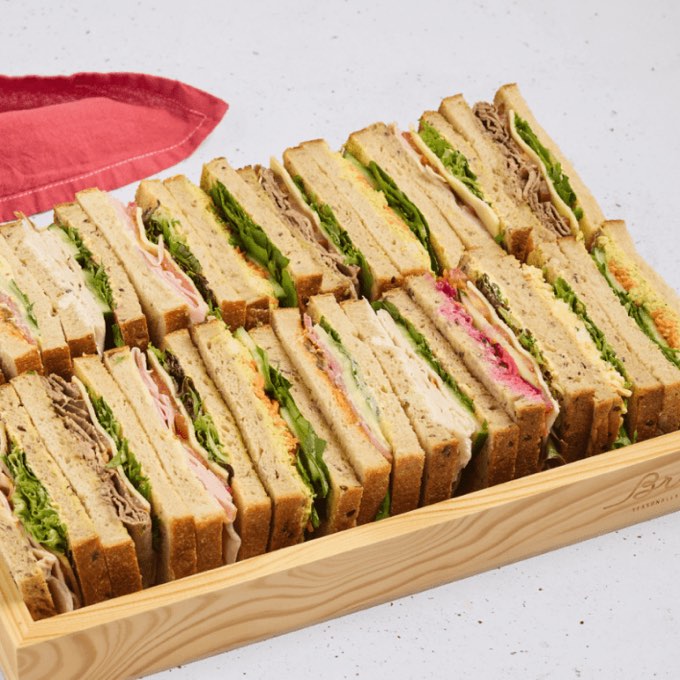
Cut a sandwich into four triangles and people will take one without committing to a whole round. That is how our point sandwiches are built: one sandwich, four triangles. Ribbon sandwiches are the other cut worth knowing, where one sandwich gives you three straight fingers.
Pick one cut per variety and stay with it. Consistent triangles in one block and consistent ribbons in another look styled; the same food cut six ways looks rushed.
Use a serrated bread knife and cut one sandwich at a time, wiping the blade as you go. Mayonnaise dragged through the next cut is what makes a home-made platter look smeared.
2. Build height instead of spreading out
The most common mistake is a single flat layer across a wide board, every piece at the same height with the board showing through the gaps.
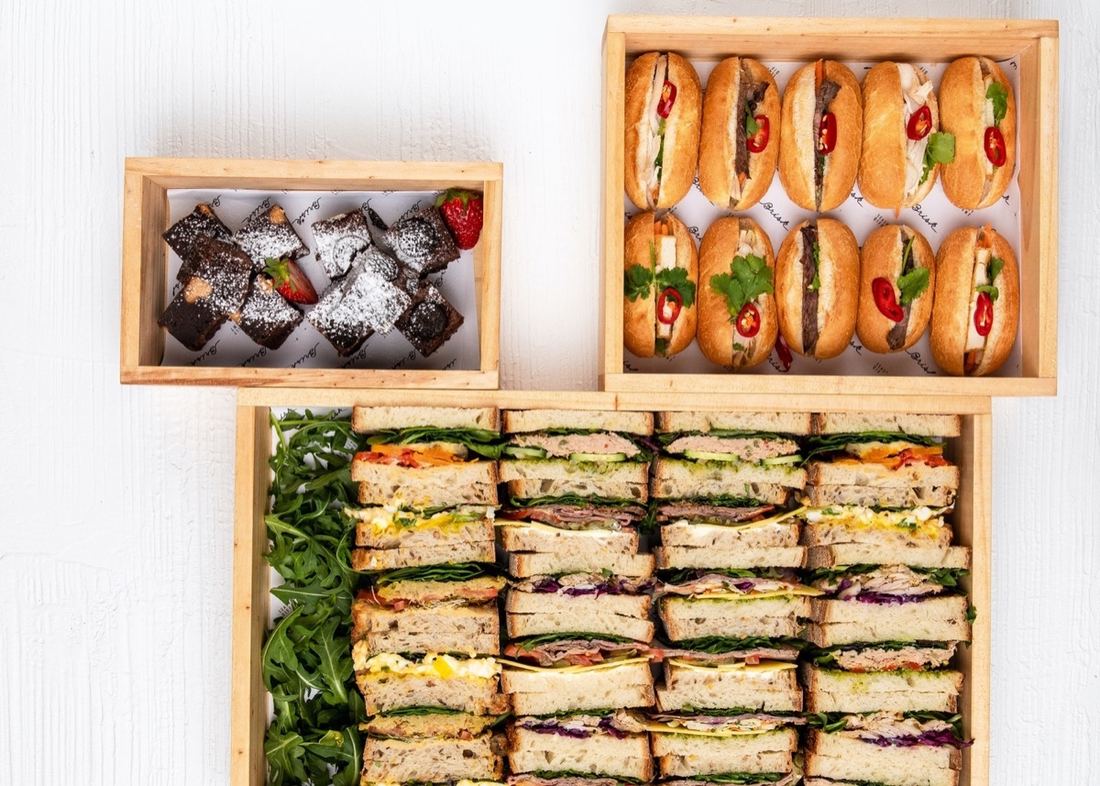
Lean the pieces in rows instead, each one propped against the one behind, so the cut faces angle up towards whoever is standing over the table. Fillings are the only colour a sandwich platter has, and this is what puts them on show. On a bigger spread, a cake stand or an upturned tray under one end does the same job.
Height also lets you keep vegetarian, halal and gluten free items apart without needing three boards on a small meeting table.
3. Colour-block the garnish
Bread is beige and so is most of what goes in it. Whatever colour you add, keep it in blocks rather than spread through.
A row of cherry tomatoes down one edge. A tight bunch of grapes in one corner. Cornichons or a wedge of lemon at one end, and micro herbs pushed into the gaps between rows.
What does not work is the same garnish dotted evenly across the whole platter, which reads as clutter from the two metres away most people first see it from. The same rule holds on a fruit platter, where colour-blocking is most of the technique.
4. Mix the breads
Three breads on one platter beat one bread, and it costs nothing to do.
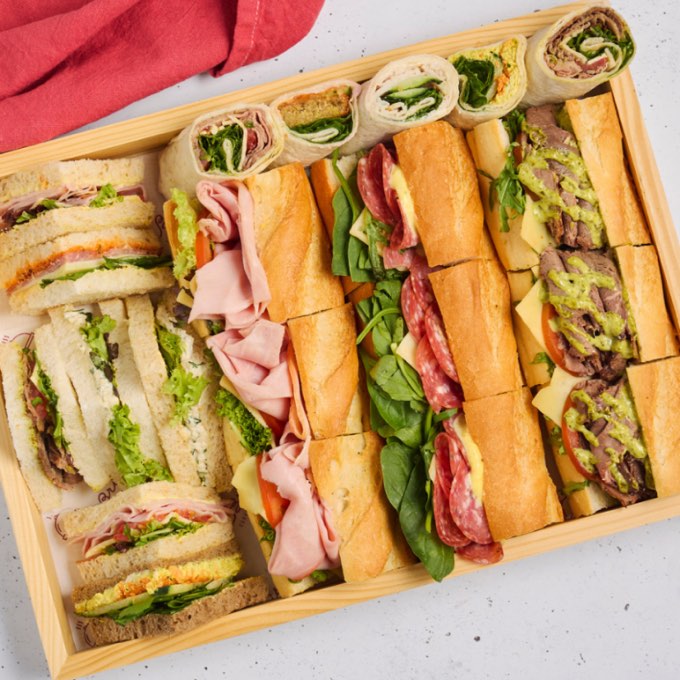
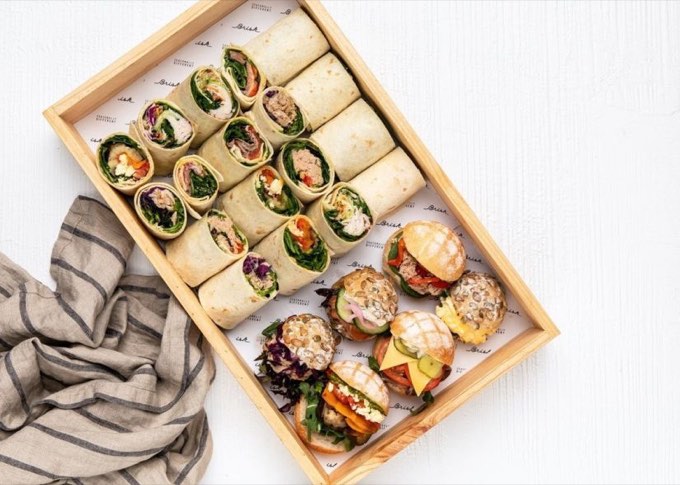
White point sandwiches next to a dark rye. Mini ciabatta rolls or bagels for shape. A spinach or beetroot wrap cut on the diagonal so the spiral shows. Sourdough is worth including if the platter has to sit out for a while, because it holds its shape under a filling better than soft white does.
Our mixed bread platter is built this way: four point sandwiches, three wraps and three baguettes on one board, $104, designed to serve up to ten people.
5. Label everything
This is the one that gets the most comments in an office, because anyone with a dietary requirement will skip an unlabelled platter rather than guess at it.
Small acrylic or card tents beside each group, with the filling written out in full. Not "vegetarian" but "roast pumpkin, feta and rocket". Colour-coded tags only work if everyone knows the code, and nobody ever does.
Gluten free items need their own board, or at least their own clearly separated section. A gluten free sandwich that has touched a wheat one is no longer gluten free, and the person who needs it has no way of knowing what happened to it before it reached the table. Our gluten free catering is packed separately for that reason.
6. Wrap the ones that travel
If the platter is going to another floor, into a car or out to a site, wrap the pieces individually instead of arranging them.
Greaseproof paper and a paper band around each half works. So do kraft sleeves, or bamboo boats for anything with a loose filling. The sandwich holds together, it survives being carried, and people can take one without handling the rest.
How to cut sandwiches for a platter, and how many you need
The count people get wrong is pieces, not sandwiches. One sandwich stops being one serve as soon as you cut it.
| You cut | You get | Pieces per person | Covers |
|---|---|---|---|
| 1 sandwich into 4 triangles | 4 triangles | 3–4 as the main lunch | 1 person |
| 1 sandwich into 3 ribbons | 3 ribbons | 3–4 as the main lunch | 1 person |
| 1 sandwich into 2 halves | 2 halves | 2 as the main lunch | 1 person |
| 10 sandwiches into triangles | 40 triangles | 3–4 | 10–13 people |
| 20 sandwiches into triangles | 80 triangles | 3–4 | 20–26 people |
Halve those piece counts when the sandwiches sit alongside other food. Two triangles a head is plenty if there is a fruit platter and a sweet tray on the same table.
If you are ordering in rather than making them, our regular platters are built to serve up to ten and the large ones up to fifteen, which gives you this:
| Headcount | Platters to order | Serves up to |
|---|---|---|
| 10 | 1 regular | 10 |
| 20 | 1 large + 1 regular | 25 |
| 30 | 2 large | 30 |
| 50 | 3 large + 1 regular | 55 |
| 100 | 6 large + 1 regular | 100 |
Drop one regular from each row if there is other food going out with it, and round up rather than down for a group with people who will take two.
For the rest of the table, our guide to how much food to order for a work lunch covers quantities, and the catering cost per person guide has the per-head numbers.
Ordering for a team this week? Send us the date and the headcount and we will come back with a costed platter mix. Get a quote.
Keeping a platter fresh from 8am to noon
Four hours on a meeting-room table in a Melbourne summer will undo a well-built board, so the presentation is only half the job.
Butter to the edges. A thin layer of room-temperature butter or spread, right out to the crust, is a moisture barrier. Bread goes soggy where nothing is protecting it.
Dry against the bread, wet in the middle. Lettuce and meat next to the bread, tomato, beetroot and chutney in the centre. Drain the wet ones on paper towel first. Beetroot will bleed through a slice of white bread inside an hour.
Damp paper towel, then cling film. Soak a few sheets, wring them out until they are barely damp, lay them over the finished platter and film over the top. Cut edges keep without the bread getting wet. Take it off as people arrive, not before.
Make them ahead, cut them on the day. Sandwiches can be assembled and covered a day early. Cutting is the part to leave until the morning, because cut edges dry fastest.
Keep it out of the sun. The end of a boardroom table under a north-facing window is the worst spot in the building. If there is a fridge, leave the platter in it until about fifteen minutes before people sit down.
Our answer to all of this is timing rather than technique. The bakery delivers bread early in the morning, the sandwiches are made just before the run goes out, and delivery starts from 7am.
What a catering platter costs
| Platter | What is on it | Serves up to | Price |
|---|---|---|---|
| Mixed bread, regular | 4 point sandwiches, 3 wraps, 3 baguettes | 10 | $104 |
| Mixed bread, large | 5 point sandwiches, 5 wraps, 5 baguettes | 15 | $155 |
| Gourmet sandwich, regular | 10 gourmet sandwiches | — | $104 |
| Gourmet sandwich, large | 15 artisan sandwiches | — | $155 |
| Everyday sandwiches, regular | 6 deli rolls, 3 wraps, 3 point sandwiches | 10 | $100 |
| Everyday sandwiches, large | 12 deli rolls, 6 wraps, 6 point sandwiches | 15 | $192.50 |
| Deli roll platter | 16 deli rolls | — | $104 |
| Wrap and roll platter | 6 wraps, 6 deli rolls | — | $104 |
By the item, if you would rather build the mix yourself: point sandwiches $10.50, ribbon sandwiches $10.50, wraps $11.60, sourdough sandwiches $11.40, baguettes $12, deli rolls $7.15, mini ciabatta rolls $7.15, mini New York bagels $7.90, mini banh mi $7.50, focaccias $13.50. Gluten free sandwiches $11.40, gluten free wraps $11.90 and gluten free mini rolls $7.90.
Order by 3pm the day before. Delivery starts at 7am, the minimum order is $80, and delivery is free to the CBD, Docklands and St Kilda Road on orders over $80. You can pay by invoice up to 14 days after delivery.
Sandwich platter questions
How many sandwiches do I need per person for a platter? Three to four triangles a head if the sandwiches are the lunch, which is roughly one full sandwich cut into four. Two a head if there is other food on the table. Our regular mixed bread platter is ten pieces and is built to serve up to ten people.
How do you cut sandwiches for a platter? Use a serrated bread knife, cut one sandwich at a time and wipe the blade between cuts. Four triangles or three straight ribbons per sandwich are the two cuts worth knowing. Pick one per variety rather than mixing cuts within a group.
How do you stack sandwiches on a platter? Lean them in rows rather than laying them flat, each piece propped against the one behind so the cut faces angle up. That shows the fillings, which are the only colour a sandwich platter has.
How do you keep a sandwich platter fresh? Butter to the edges as a moisture barrier, dry fillings against the bread and wet ones in the middle, then cover with barely damp paper towel under cling film. Cut on the day and keep it out of direct sun until fifteen minutes before serving.
How do you make a sandwich platter look nice? Consistent cuts, height instead of a flat layer, colour kept in blocks rather than scattered, and three breads instead of one. Labels beside each group finish it.
How much does a sandwich platter cost in Melbourne? From $100 for a regular everyday sandwiches platter to $192.50 for the large version. Mixed bread and gourmet sandwich platters are $104 regular and $155 large.
Order sandwich platters
Browse the sandwich platters range or the wider sandwich catering menu, or get a quote with your date and headcount and we will put the mix together.
We have been doing this in Melbourne for thirty years, for 2,000 active clients, at around 250 deliveries a day, with 4.9 stars from 91 Google reviews.